Posts

Machine Learning and Predictive Scaling

Machine Learning is a branch of artificial intelligence (AI) that focuses on the use of data and algorithms to provide predictive analytics, which can gradually self-improve its predicting accuracy over the learning course. Applying Machine Learning in a wide variety of use cases has become a fast growing phenomenon in recent years. This includes auto scaling in cloud computing.  Auto scaling, in cloud computing, refers to the capability of scaling the compute resources as per the demand at the time – when the compute needed is higher than the system is currently running, the system scales out (adds more) compute resources to better share the load; when the needed compute is lower, the system scales in (reduces the capacity of) the compute for the benefits both financially and environmentally. Some metrics are used to indicate the level of needed compute. For example, CPU utilisation is one of the common metrics used. Let’s use Amazon EC2 compute service as an example. Say there ar...
Data Encryption in Cloud

(This was the streamlined transcript of a community talk I prepared for some school students.) Hello friends, Thanks for the opportunity today for me to talk about a fascinating technical topic – data encryption.  Data, in common terms, is information: information about something or someone. In our today’s topic, data means the information processed and stored in computers, on the internet, and in telecommunication systems. Computer data, as per Oxford Languages, is the quantities, characters, or symbols on which operations are performed by a computer, which may be stored and transmitted in the form of electrical signals and recorded on magnetic, optical, or mechanical recording media.  Not surprisingly, with more and more things online, in the clouds, the volume of computer data has increased exponentially. Think about all the social media contents uploaded, all the websites, online maps, online banking, video conferences, emails, the assignments you wrote that stored in Goog...

Landing Zone Accelerator on AWS

Image
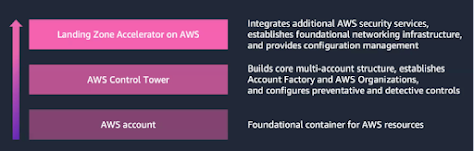
Tom is an enterprise’s IT manager who leads a team that is responsible for driving the company’s cloud transformation. They have started a project on AWS Landing Zone with Control Tower, with the aim to introduce the number of benefits that their cloud service partner had been talking about for quite some time. Tom and the team are conscious that there can be various approaches on many aspects. They also have questions; for example, after the Control Tower managed Landing Zone is deployed, how can they maintain the best practices, prevent architectural and operational drifts – on the ongoing basis. They are in a sector that demands greater and greater data security governance so logically they would like the peace of mind knowing that the Control Tower structure will continue to fulfil this purpose, without risking itself becoming a toolset that is too complex, for their relatively small team. Their cloud service partner suggested for them to consider Landing Zone Accelerator.  The...

AWS Cloud Day Melbourne 2023

On 02 Aug 2023 AWS held a Cloud Day conference in Melbourne. I was quite pleased with the event’s quality (speaking as someone who over the years, has attended a large number of conferences in the ICT industry). The pacing was wonderful, the contents carefully arranged, and the speakers were engaging. I made a few notes / observations on the sessions I went to.   Generative AI Generative AI was definitely a hot talking point. Besides heavy featuring in the Keynote, a number of speakers touched on it in sessions that focused on other topics – people could make connections from various angles.  The common consensus on the phrase Generative AI, or GenAI, is that it describes the broad range of artificial intelligence that can create a wide variety of data – text, images, videos, audio, code, and 3D models. ChatGPT, Google Bart and Microsoft Bing AI are several well-known examples.  Generative AI can leverage large amounts of unlabelled data to pre-train the machine lear...

Migration to the Cloud – Introduction of Software Licensing Assessment and Optimisation

Image
One of the key considerations in a cloud migration is the existing software that an organisation has been using. Being able to continue using existing software that has been supporting the workloads, or being able to ensure the operational order of an alternative method – is important when a migration to cloud is being evaluated. Logically, the entitlement to the use of a software is dictated by the software vendor, typically with a series of conditions. That is, if the software vendor’s set conditions are such, then the current software used by an organisation on-premises will not be able to be used in a cloud environment, even if it is technically straightforward to install this software on cloud compute. The non-technical rules on how a software is authorised to be used and on what conditions is known as the licensing entitlement, or licensing conditions. To help with the explanation, some examples are used below, mainly on Microsoft licensing, with a bit on Oracle software as well....

AWS Firewalls - Stateless, Stateful and Deep Packet Inspection (DPI)

A firewall in a car blocks potential harms (fires) in the engine compartment from spreading to the passenger compartment, but still allows control cables and shafts (ultimately for the purpose of permitted communication) to pass through. The same concept can be likened to access control technologies in data communication. In ICT, firewalls may offer additional functionalities but access control is always a core feature – and in turn a core expectation of data security. TCP/IP data communication is in the format of packets (billions and trillions of them), with each packet comprising of two portions: header(s) and data contents (payload). The communication protocols use a layered approach: the payload with the lower communication layer’s header together go into a higher layer’s payload with another header added - and such enveloping can go on a few times.  Static access control is a basic form of access control - commonly known as operating at OSI (Open Systems Interconnection) Laye...

The Organisation’s Control Tower Managed Landing Zone Is Finally Here. What More Is There to Think About?

Image
Enterprises and organisations have been having exciting journeys on modern clouds. In recent years, Governance at Scale (G@S, or GaS as an immediately memorable name!) is something many organisations have been seeing tremendous values in. By introducing automation in areas like account management, policy enforcement, security controls, budget and resource management, G@S helps to drive down manual processes and eliminate all the flaws that come with them in clouds.  In AWS cloud, Control Tower managed Landing Zone is the native toolset on this aspect. As people say, you do not really need Control Tower for setting up a landing zone, particularly if you would like to play around in a lab environment. But without Control Tower the setup would quickly bend under its own weight on the manual administration, provision and management. So for use cases of enterprises, you may well say, yes I do, in fact, really need Control Tower. Now let’s imagine we are from an organization that complet...